
Key to finding joy during hardship

I know this might sound too simple.  I know you could be rolling your eyes as you read this. But give this a chance.  A huge key to regaining some of your joy during challenges or after a heartbreaking event is…to focus on the things for which you can be thankful.

All of us tend to focus on what we don’t have instead of what we do have.  By doing so, we become bitter, jealous, and depressed women.  Now if you actually enjoy being bitter and depressed, you just go right on concentrating on what’s wrong in your life.  However, there is a better way to live.  God recommends it in the Bible.  It’s called being thankful for what you do have.  1 Thessalonians 5:18 tells us to “give thanks in all circumstances“.  This means disciplining your mind to focus on what is good and right and beautiful. God puts it this way in Philippians 4:8 “whatever is true, whatever is noble, whatever is right, whatever is pure, whatever is lovely, whatever is admirable—if anything is excellent or praiseworthy—think about such things.”

Do you have shelter and plenty of food to eat each day?  Wow! You’re in the top 10% of the entire world!  Do you have someone in your life (husband, mother, friend, child) who loves you?  Wonderful!  Do your legs and hands work?  Can you see, hear, and taste?  Thank God for the health that not everyone enjoys.  Has God made himself known to you and drawn your heart to Him?  Awesome!  That means He thinks you’re special and He decided before the beginning of the world to select you to adopt as His child!

Yes, there is a time to grieve losses in our lives.  But we can’t stay camped out there!  Let’s make a concerted effort to focus our minds on being thankful.  Little by little, you may find your joy returning, even during hard times.

Are you catastrophizing in marriage?

Have you ever heard the word catastrophizing?  It happens when a person fixates on the worst possible outcome and treats it as likely, even when it is not.  Unfortunately, this often happens between a husband and a wife!  Have you fallen into this dysfunctional and destructive trap yourself?

See if any of these patterns sound familiar.  Do you often believe the worst about your husband’s intentions and motivations? Do you tend to take one failure or disappointment regarding your husband and then blow that up into a sweeping condemnation of him altogether?  Do you tend to make negative assumptions about him?  Do you fixate on your husband’s shortcomings or the ways he fails to meet your every desire?   Do you believe he will let you down or disappoint you before he’s actually done so?!  Then you have likely fallen prey to the common trap of “catastrophizing”!  And you’re not alone.  I, too, have fallen into this unhealthy way of thinking far too frequently.

Here’s the remedy for catastrophizing.  The minute you find yourself going down that line of negative, fear-based, hopeless path of thinking about your husband, immediately catch yourself, and hit reverse!  In that moment, switch gears and start mentally tallying the good qualities of your husband.  It’s amazing how your feelings toward your husband will instantaneously change as you start focusing on the positive qualities he has (or even the bad things he does NOT do).  This is the essence of God’s instruction to us in Philippians 4:8 Finally, brothers and sisters, whatever is true, whatever is noble, whatever is right, whatever is pure, whatever is lovely, whatever is admirable—if anything is excellent or praiseworthy—think about such things.

Ridding financial stress from marriage

So many couples, especially young couples, argue over money.   They disagree over how much to spend, how much to save, the financial priorities, whether to help loved ones in need, whether to give to the church, and on and on.

You might not be aware, but the Bible actually gives a ton of guidance on how to handle money and possessions!  I have found 3 particular Bible principles to be especially helpful for couples who have been suffering from financial tension and strain in their marriages.  Allow me to summarize those principles for you.  (You can look up the verses for yourself and ask the Lord to counsel you directly).

Bible Principle 1:  Live intentionally below your means!  (Hebrews 13:5)  So many couples are under heavy financial strain because there is no real cushion in their budget.  They’ve bought the biggest house they could possibly afford or the most expensive car they could afford, and then when something unexpected comes up, they become super stressed-out and start ugly arguments!

Bible Principle 2:  Don’t wear yourself out or stress yourself out by working too much to accumulate possessions and wealth because those things will mean nothing at the end of your life.  The only thing that will matter is your love for the Lord and the people he placed in your life. (Proverbs 23:4)

Bible Principle 3:  Take a step of faith and cheerfully give some of your money back to the work of the Lord because He promises to reward those who trust Him by doing so!  (Malachi 3:10).  I’ve done this faithfully for several decades whether I felt like I had the money to give or not.  The Lord has always provided for me, sometimes in strange and unusual ways!

Dealing with a husband’s anger

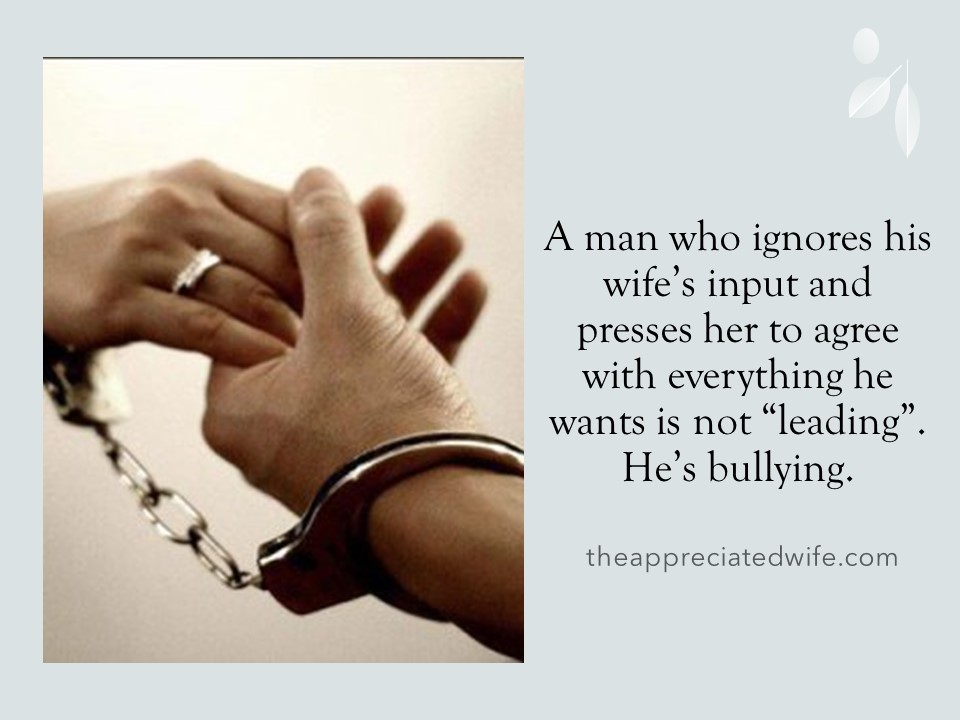
Does your husband tend to give full vent to his temper when you disagree with his opinion or his desires?  When you guys have a conflict, does he end up yelling at you or saying mean things?  When this happens, deep heart wounds occur.  There must be a better way to handle conflict!  Here are a couple things you can do to help put out his anger fire before it scorches you:

1) If a disagreement is starting to get a bit ugly, YOU can simply stop arguing! Tell your husband that you love him and you want to take a time-out before discussing the issue further.  Tell him that you’re going to think and pray about his perspective and that you’d love him to do the same for you.  Then agree to talk about it again later that day or tomorrow.  

2)  Remain calm even if your husband does not.  Refuse to match his loud volume or hurtful comments.  In fact, if he becomes emotionally abusive, calmly tell him you do not allow anyone to speak to you that way, and then walk away.  If he follows you and continues the emotional abuse, get in your car and drive away.  Do not tolerate aggressive, harsh, or wounding treatment from your husband during conflict.  That is not God’s plan for how a wife should be treated.  Colossians 3:19 says, “Husbands, love your wives, and do not be harsh with them.” 

4 things to do if he disappoints you

Every wife is going to have moments (or weeks or months!) that she’s disappointed with her husband.  No man is perfect, and your husband is bound to frustrate you, annoy you, or fail to meet your expectations from time to time.  The question is:  How can you keep from being seriously discouraged or resentful during those times?  I have found 4 things to be really helpful:

1) Clearly communicate your expectations and desires!  Men are not mind-readers, yet often wives expect their husbands to “just know”!  So, think about the areas in which you’ve been frustrated or disappointed. Then calmly and clearly tell your husband what you desire or need, as well as how much you’d appreciate him making an effort to meet those needs and desires.

2) Be grateful for what he does right!  Isn’t it strange how most wives tend to gravitate to focusing on what their husband is doing wrong, but barely give a second thought to what he’s doing right?!  Stop right now and ask God to help you see the many good things about your husband and the positive things he does.  This is the essence of Philippians 4:8… “whatever is true, whatever is noble, whatever is right, whatever is pure, whatever is lovely, whatever is admirable—if anything is excellent or praiseworthy—think about such thing.”

3) If your husband is actually sinning against you, it’s time to stop wringing your hands and it may be time to take action!  In Matthew 18:15-17, Jesus instructs us to confront the person who sins against us, and to even get others involved if necessary.

4) Pray, and never give up!  Prayer truly can move mountains, and Jesus tells us in Luke 18:1 that we “should always pray and not give up“.  So go to battle in prayer, and ask God to reveal His love to your husband and to mold and shape your husband’s heart.

Avoid this button in relationships!

Do you keep replaying your husband’s past mistakes over and over again in your mind?  Do you find yourself dwelling on how he’s disappointed you in the past?  Let it go!  Thoughts like that become toxic…to you and your marriage.  Hebrews 12:15 makes this point:  “See to it that no bitter root grows up among you to cause trouble and defile many.”  If you keep rehearsing your husband’s past failures, you will end up growing more and more resentful of your husband.  The resulting bitterness acts like poison to your own heart.  You become a dried up, miserable woman. 

Even more damage is caused when you verbalize those past mistakes to your husband.  Yet many wives do that.  They repeatedly bring up their man’s past mistakes and almost wield them as a weapon against their husband.  His heart gets sliced and diced in the process.  His heart becomes poisoned against his wife as well.

It’s time to decide to release your husband from his past failures. It’s time to stop hitting the replay button where you keep reviewing his past sins and the ways he has disappointed you!  The Bible is pretty clear about your need to release bitterness and resentment. Ephesians 4:31 says “Get rid of all bitterness, rage and anger…”  So choose to exercise the same grace God has given you!!  News flash:  You’re not perfect either.  By the way, releasing your man from his past mistakes doesn’t mean you should ignore current sin.  If he is currently sinning against you, determine to respectfully confront him and work through the problem, perhaps with the help of a counselor or pastor.

Don’t let conflict avoidance cause this!

I’m an expert conflict avoider.  How about you?  I grew up in a household where there was a lot of yelling and rage and verbal abuse.  As a result, everything within me always tried desperately to avoid anything in my marriage that could have resulted in tension, raised voices, or anything remotely resembling conflict.

However, avoiding conflict is a recipe for disaster in a marriage.  I learned that the hard way in my first marriage, which failed.  Here’s the thing.  If you don’t address the things that are really bothering you about your husband or your marriage, a seed of bitterness is planted in your heart.  That seed slowly takes root and grows, and after months and years go by, you will most likely grow to despise your husband and want a divorce!  Not good.

So, commit to respectfully, lovingly, and diligently address the things that are bothering you within your marriage.  Hebrews 12:15 warns us not to let “any bitter root grow up among you to cause trouble…”  So, ask God to give you the courage to gently and respectfully discuss your concerns with your husband, and determine to work all the way through those concerns until they are resolved.  Ask God to give you the courage to express your needs and desires to your husband.  Do not become invisible.  When you start stuffing your feelings and immediately cave in during disagreements, toxic resentment will start to grow inside you. Don’t let that happen!

Best question to ask when upset

There’s a golden phrase I discovered many years ago.  When I started using it, I found it helped prevent my husband from getting defensive when I was upset or frustrated about something he had said or done.  Instead of accusing him of doing something wrong, I learned to kindly and sincerely ask this question: “Help me understand why…”

This simple question prevents the monster of defensiveness from raising its ugly head.  By asking your husband to “help me understand”, you’re communicating two things to your husband.  1) You really do care about his perspective and feelings, and 2) You’re acknowledging there may actually be a legitimate reason for why he did or said whatever.  At least, you’re giving him a chance to explain himself before you start arguing with him or condemning him!!  

By asking your husband to help you understand his behavior or perspective, you’re avoiding a foolish argument.  Proverbs 18:2 says “Fools find no pleasure in understanding but delight in airing their own opinions.”  By asking your husband to help you understand his perspective, you’re pleasing both God and your husband by living out the instructions in Philippians 2:4 “Each of you should consider not only your own interests, but also the interests of others.”

Try this phrase when you sense a potential ugly argument is headed your way.  You can not only use this phrase with your husband, but with your children, your in-laws, your co-workers, your boss, and more.  Again, the phrase (actually a question) is….”Help me understand why…”

Don’t give the devil this foothold!

The Bible says in Ephesians 4:26 – 27, “In your anger do not sin”: Do not let the sun go down while you are still angry, and do not give the devil a foothold.

Well, over the years of my marriage to late husband Raul, I didn’t always obey that instruction, and my disobedience was almost disastrous!  One occasion comes to mind as a good example.  My husband had acted in a way that really bothered me.  I was steaming for hours and couldn’t even bring myself to talk to him about it because I feared we’d get embroiled in a huge conflict.  So, I went to bed early, by myself.  I went to bed by myself, wrapped in a blanket of resentment, bitterness, and ugly thoughts about my husband.  As I lay there steaming, that resentment started morphing into thoughts such as “I’d be better off without him” and “He’s such a jerk. I’m going to be cold as ice toward him from now on.”

I am so thankful the Holy Spirit finally broke through and prompted me to get out of bed and go speak with my husband.  I sensed that I was giving the devil a “foothold” in my marriage through me stuffing the issue and letting resentment grow.  So, I went and found my husband in the living room, knelt by his side as he was sitting on the couch and told him that I truly do see so many good qualities in him.  I also told him why his behavior had bothered me. 

I know you’re thinking he agreed with my assessment, but he didn’t!!!  However, a good thing did happen.  We calmly acknowledged our difference of opinion, and I was able to go to sleep in peace.  There was no wedge between me and my husband.  Don’t allow the enemy to gain a foothold in your marriage.  Resist the temptation to go to sleep with simmering anger and resentment.

Expectations in marriage

We ALL bring expectations into our relationships.  Much of the time, our expectations are somewhat subconscious and subtle.  We don’t spend a lot of time pondering whether our expectations are realistic or correct.  However, we often do spend a lot of time being disappointed or frustrated with the other person for failing to meet our expectations or for causing us misery similar to painful relationships we had in childhood.  It’s time we adjusted our expectations, especially when it comes to marriage!  There are two different ways we may need to adjust our expectations.  If one way doesn’t apply to you, I bet the other one will.

First, many of us subconsciously expect our husbands to be pretty much perfect.  We wouldn’t say that out loud because it sounds rather ridiculous, but nonetheless, we find ourselves sinking into despair if our husband isn’t empathetic enough, or romantic enough, or providing enough.  We become super frustrated if he wrestles with an addiction, doesn’t play with the kids enough, or doesn’t seem to shoulder his share of the responsibilities in taking care of the home.  News flash: Your husband isn’t Jesus!  He can’t be perfect in every way because he’s human! There is only one person who can perfectly meet all your needs, and that person is Jesus. Philippians 4:19 And my God will supply every need of yours according to his riches in glory in Christ Jesus.  So look to Jesus as your main source of love and security, and let your husband off the hook.  Be thankful for the good qualities your husband does have and cut him a little slack in the areas where he is less than perfect.

However, for some of you, your dysfunctional childhood led you to expect that men would always treat a woman poorly.  You experienced an abusive environment in your family of origin, so it seems somewhat normal for you to endure abuse from your husband.  Change your expectations!!  It is not okay or normal for a husband to engage in a pattern of verbal, mental, spiritual, or emotional abuse of his wife.  It is never okay for a man to physically harm his wife.  If you are experiencing such abuse, I urge you to seek help immediately.  I urge you to separate yourself from your husband, at least temporarily, while asking him to get serious help for his anger problem.  As I was contemplating Bible guidance for a woman in an abusive relationship, a principle came to mind from 1 Corinthians 7.  Paul was writing to slaves (who were in an oppressive and sometimes abusive situation), and he said this in verse 21, “if you can gain your freedom, do so.”   Do not expect or tolerate abuse in your situation.  It may be necessary for you to gain freedom from abuse through a legal separation.