
Do not make major decisions if…

You may have heard of the acronym H.A.L.T.  It stands for hungry, angry, lonely, tired.   It is a caution often used in addiction recovery where people are urged not to make any drastic decisions when one of those 4 conditions applies.

That’s a really good caution for wives as well!  Don’t make any major decisions about leaving your husband, filing for divorce, or even giving full vent to your temper if you are hungry, angry, lonely or tired.  However, I would like to add one more condition.  Don’t make any major decisions when….it’s that time of the month!!  Women are often so overly-emotional in the days leading up to their period, that we become drama queens!  Everything happening around us is exaggerated in intensity.  So, even though you feel like reacting in a dramatic way, remind yourself to pause and see if you still feel the same way 3 or 4 days later.

This verse comes to mind.  James 1:19-20  My dear brothers and sisters, take note of this: Everyone should be quick to listen, slow to speak and slow to become angry, because human anger does not produce the righteousness that God desires.

Feel like ending your marriage?

Do you feel tempted to throw in the towel regarding your marriage?  I know it can be tempting to just bail out, but please let me encourage you to do everything you can to fight FOR your marriage!

When you’re going through a serious challenge in your marriage, it seems right to choose the path where the pain can be quickly relieved.  In a nutshell, it often seems best to choose divorce.  But I’ve been through divorce, and I can honestly say that even though some of your pain will be relieved, you’ll be faced with a whole new set of problems and heartbreak.

So, maybe you should try something else.  What if you were to seek outside counsel for your marriage? What if you were to spend time on your knees crying out to God on behalf of your marriage? What if you were to courageously, but respectfully, confront your husband if he is seriously out of line in some area?  That could be the beginning of a turn-around in your marriage.

And also, please consider that other people are watching how you handle challenging times. Your children are watching how you handle this.  Are you teaching them to bail out of situations and relationships when the going gets tough, or are you showing them how to persevere and do the hard work to restore the relationship?  Meditate on Hebrews 12:1-2 “Therefore, since we are surrounded by so great a cloud of witnesses, let us also lay aside every weight, and sin which clings so closely, and let us run with endurance the race that is set before us, looking to Jesus…”

Yes, sometimes ending the marriage may be the right path, especially if there has been a pattern of affairs or abuse.  But often, we choose to end a marriage because of resentment or unmet expectations or because “he’s not making me happy”.   Please, please, please work to address the issues that are prompting you to consider divorce.  There may be a way to develop a healthier perspective and a healthier relationship.  This will likely take work, and the process could be painful, but often good things happen when we persevere through the pain!

Dealing with a controlling husband

Many women struggle with following the leadership of their husbands because their men seem to be controlling, manipulative, or inconsiderate.  When is it proper to submit to such “leadership” and when is it appropriate to respectfully draw a boundary?

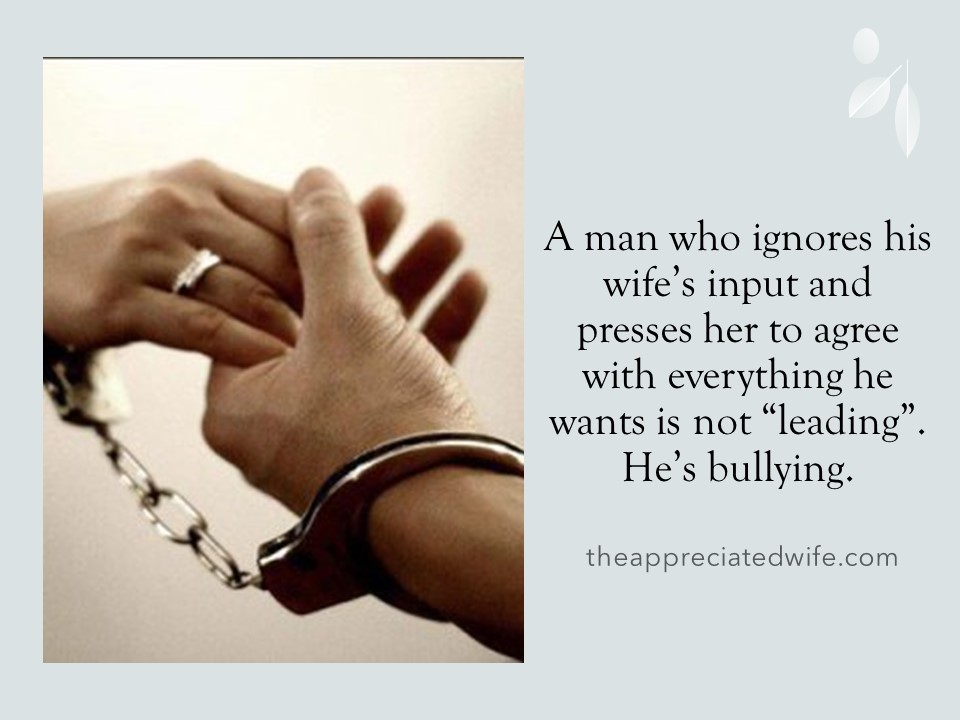
Well, according to the Bible, a godly husband will love his wife in a selfless way (Ephesians 5:25) and will treat his wife with consideration and respect (1 Peter 3:7).   These verses give us a pretty clear picture of what a godly husband looks like.  As a result, it seems pretty clear that a controlling husband, one who bullies or intimidates his wife and children, is NOT behaving in the way that God intended.

I believe a wife can respectfully confront a husband who is trying to control, intimidate, bully, or manipulate her.  She may need to lovingly, but firmly, establish boundaries on what she will tolerate. This might mean simply walking away when he begins to start bullying or controlling.  If he continues to follow you, it could mean even leaving the home for awhile. I would add that it would be very wise to consult with other godly women, a pastor, or a counselor before moving forward in establishing boundaries.  It’s always best to make sure that you are evaluating the situation clearly.

Must you submit to your husband?

I don’t claim to be the authority on the Bible’s instruction for wives to submit to their husbands, but after spending considerable time studying God’s Word, here’s what I have come to believe on this controversial subject.  God definitely plans for all of us to live under authority.  I would imagine He knows this prevents chaos from breaking loose!  So, in a family unit, God has placed the man as the authority, and the wife and children are under his authority.  If we used a business analogy, it’s rather like your husband is the general manager who must make the major decisions on the policy and ground rules for how the business will operate.

So what does this look like for a wife?   This means choosing to treat your husband respectfully and allowing your husband to lead you and your family.  Instead of you jumping into to take over leadership, and instead of you deciding how everything should go, you allow your husband to lead.  However, just as in a business, a wise husband will value the input and sage counsel of the wife who is usually more intimately involved with handling family matters each day.  

Now, where “submitting” to your husband can go haywire is when the husband veers off course morally or Biblically.  When the husband starts leading the family (or requesting the family) to engage or support wrong behavior, then the wife need not submit to such decisions.  Her first allegiance is to God and His commands.  God is the ultimate authority.   I believe that is why the Bible includes a “qualifier” in one of the instructions for the wife to submit to her husband.  It is found in Colossians 3:18, which says “the wife must submit to her husband, as is fitting in the Lord“.   If your husband is asking you to do something that is not “fitting in the Lord”, I don’t believe you must submit to such leadership.  I believe a wife can respectfully draw the line.   In addition, it’s my belief, from studying all of God’s Word, that “submission” does not mean the wife must be a doormat who tolerates disrespectful or even abusive behavior by her husband.  Such behavior by the husband is not “fitting in the Lord” either.   Submission is not being a doormat. 

7 words for when people hurt you

We’re all going to be hurt by others during the course of our lives, sometimes over and over again!  The question is not “How do I avoid being hurt by others”, because you can’t control other people.  The real question to ask is, “How can I heal and move on with hope, peace and joy?”  Over many years of helping women, and after recovering from numerous heartbreaking offenses myself, I’ve come to realize that seven words are key.

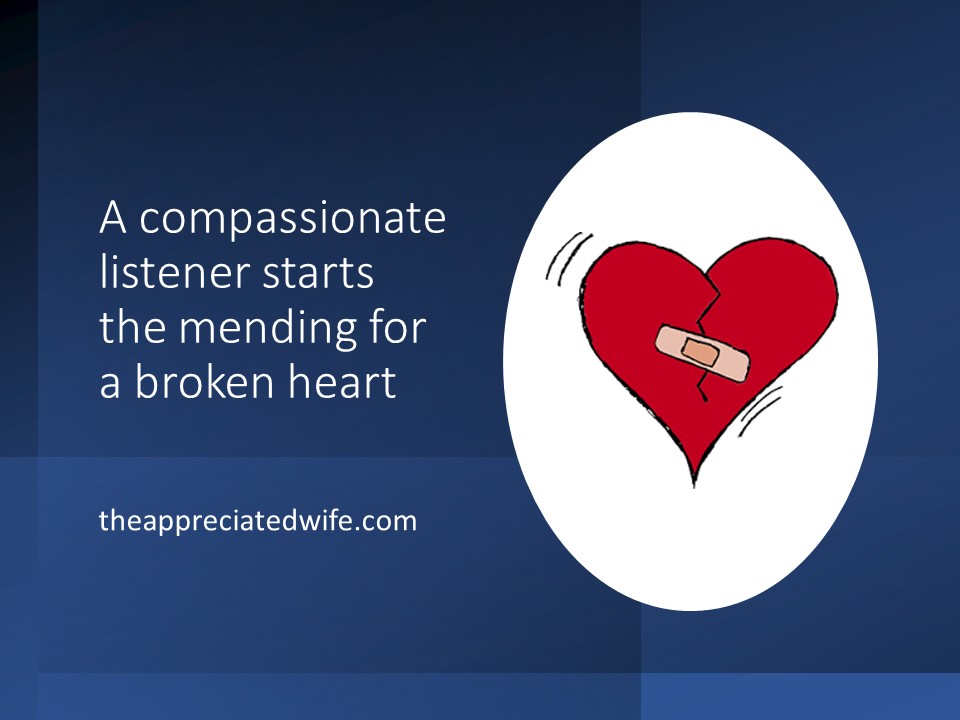
The first 3 words are: That was wrong.  You need to be able to tell your story to a compassionate listener who then validates the wound by saying those precious words, “That was wrong”.  Something very healing happens the moment someone else listens to your story, shows empathy for the pain you suffered, and then validates that the person who wounded you was wrong to do so.  This is Biblical.   1 Peter 3:8  “Finally, all of you, be like-minded, be sympathetic, love one another, be compassionate and humble.”  You need to hear those words, “That was wrong.”  So, ask God to lead you to that person who can be a compassionate listener to your story.

However, after you’ve told your story to that compassionate listener, and after a short time of grieving your pain with the Lord, you then need to move on to the other 4 words:  Pivot from your pain.  Far too many people get stuck in their pain and subconsciously develop a victim identity.  This is NOT God’s plan for you!  God doesn’t intend for you to be sidelined with grief, mired down in hopelessness, or burdened with a victim mindset.  He actually instructs you to forget the past and turn forward with hopeful anticipation!  Isaiah 43:18 “Forget the former things; do not dwell on the past. 19 See, I am doing a new thing!” 

So, after receiving empathy from that compassionate listener, stubbornly pivot from the pain and look forward.  Ask God to show you the purposes He has for you this day, purposes that will bring you joy and peace.  God has good plans for you!  Romans 15:13 May the God of hope fill you with all joy and peace as you trust in him, so that you may overflow with hope by the power of the Holy Spirit.

The art of the pause…when upset!

When we feel angered, or disappointed, or frustrated with our husband, it’s so natural to immediately give in to our emotions and let our husband know exactly what a failure he is!  We feel entitled to unleash our fury and it actually feels kind of cathartic for a moment.  It lets the pent-up steam out of our bodies. Whew!

However, the damage we cause to that person in the process of our “venting” can have the opposite effect of what we desired.  We were hoping the person would immediately grasp how wrong they’ve been, quickly apologize, cheerfully repair the damage they’ve done and humbly seek to win back our trust and respect.  Unfortunately, when we give full vent to our anger and disappointment, without waiting on God’s timing, we can crush that other person with condemning words spoken in the heat of the moment.  In response to our anger and harsh words, that other person usually becomes defensive and lashes back at us…or withdraws from us and goes off to self-medicate in an unhealthy way.  Neither option is good!

It’s so much better for us to pause before venting our anger!  During that pause, you might have to leave the room to spend a moment with God, but it’s so worth it!  Ask God to show you when to speak to your husband, what exact words to use, and how to offer encouragement and hope…even if you’re asking for him to change his behavior.

Here are 4 Bible verses that might be worth printing out for yourself.  They remind us to be patient, to wait for the Lord’s guidance and to do what HE says you should do instead of reacting impulsively!

Romans 12:12 Rejoice in our confident hope. Be patient in trouble, and keep on praying.

Proverbs 3:5-6 Trust in the Lord with all your heart; do not depend on your own understanding.  6 Seek his will in all you do, and he will show you which path to take.

Psalm 27:14 Wait patiently for the Lord. Be brave and courageous. Yes, wait patiently for the Lord.

Psalm 32:8 The Lord says, “I will guide you along the best pathway for your life.     I will advise you and watch over you.”

Examples of relationship boundaries

I get asked quite often about boundaries in relationships. The subject of boundaries is a topic tossed around a lot, and women sort of instinctively know they need boundaries in relationships, but they don’t exactly know the how, what, when and whys of healthy boundaries!

First let me explain that there is a difference between asking your boyfriend or husband to change and setting a boundary.  A boundary is not a request for the other person to change.  A boundary is deciding what YOU will do to protect yourself physically, emotionally or mentally from the other person’s harmful or destructive behavior.  A boundary basically says to that other person, “I can’t control your choices, but there are some things I CAN do to control how your choices affect me”.

Let me give some examples:

  • A husband refuses to stop looking at pornography and that choice wounds his wife’s heart.  She makes a request for him to stop (and most likely to seek serious help for that addiction), but she can’t MAKE him stop.  So, she establishes a boundary.  She tells him if she continues to catch him looking at porn, she will move to a separate bedroom or even separate from him entirely until he gets serious help for his problem.  That’s setting a boundary.
  • A husband is emotionally abusive and that wounds his wife.  She makes a request for him to stop, but she can’t MAKE him stop. So, she establishes a boundary.  She tells him if he screams obscenities at her or degrades her even one more time, she will immediately leave the room (or the house) because she won’t tolerate that kind of behavior.  If the emotional abuse continues, she might set an even larger boundary and tell him she will need to separate until he seeks serious help.  That’s setting a boundary.

By the way, boundaries are Biblical.  Here’s an example from Titus 3:10 Warn a divisive person once, and then warn them a second time. After that, have nothing to do with them.  And 1 Corinthians 5:11  I am writing to you that you must not associate with anyone who claims to be a brother or sister but is sexually immoral or greedy, an idolater or slanderer, a drunkard or swindler. Do not even eat with such people.

Key step before making big decisions

I was reading the creation story the other day and was struck once again at how easily Satan deceived Eve.  Genesis 3:1-6   Now the serpent was more crafty than any of the wild animals the Lord God had made. He said to the woman, “Did God really say, ‘You must not eat from any tree in the garden’?”  The woman said to the serpent, “We may eat fruit from the trees in the garden,  but God did say, ‘You must not eat fruit from the tree that is in the middle of the garden, and you must not touch it, or you will die.’”   “You will not certainly die,” the serpent said to the woman.  “For God knows that when you eat from it your eyes will be opened, and you will be like God, knowing good and evil.”   When the woman saw that the fruit of the tree was good for food and pleasing to the eye, and also desirable for gaining wisdom, she took some and ate it.

What struck me in this account is that the cunning serpent (the devil) was wise enough to whisper enticing words of deception to Eve when she was all alone.  Adam wasn’t on the scene.  Why was the devil so effective?  It would appear that part of the reason for his success in tempting Eve to make a horribly wrong decision is because she was not with Adam.   She consulted no one about the temptation she had received.  She consulted no one during her deliberation as to whether to actually eat from the forbidden tree of good and evil.  She consulted no one before making a huge, life-changing decision.  It seemed beneficial to her.  So, she just did it!

We can learn from Eve’s mistake.  If you’re considering a major decision in life (quitting your job, leveraging all your savings on a new money-making idea, separating from your husband, bailing your teen out of natural consequences of bad decisions, etc), pause before acting!  Consult a godly mentor.  Better yet, pray with several wise and godly people in your life.  Ask them all to seek guidance from the Bible and the Holy Spirit.  You will often spare yourself unnecessary pain in the long run!

Mrs. Holy Spirit??

There’s a fine line between confronting someone who is sinning against us and confronting someone about their sin in general.  As I read the Scriptures, it is pretty clear that we are supposed to confront our husbands or anyone who is sinning directly against us.  Jesus gives us this instruction in Matthew 18:15-17 and also in Luke 17:3.

However, sometimes we go too far and start to act like we’re the Holy Spirit!  It is not our job as a wife to convict our husbands of each and every one of their sins.  God says that’s the Holy Spirit’s job.  In John 16:8, Jesus says the Helper (Holy Spirit) “will convict the world concerning sin and righteousness and judgment”.  

This means it’s not your job to be constantly pointing out your husband’s flaws, reminding him of his imperfections, and chastising him for falling short of God’s perfect standard.  A wife is NOT Mrs Holy Spirit!  In fact, when we start acting like we are the Holy Spirit, we start to become that quarrelsome wife mentioned throughout Proverbs.  She is compared to a constant dripping of a leaky roof.  Hmmm.

Courage to set boundaries

Have you ever caved in when you should have set boundaries in a relationship because of the “what if” questions?  What if he leaves me?  What if he leaves me and I won’t be able to take care of myself?  What if he gets really upset if I confront him?  What if….?

When you find yourself paralyzed with fear because of the “what if” questions, it usually means one of three things.  Either you don’t really trust God when he says in Hebrews 13:5 that he will “never leave you nor forsake you”.  Or it means you have allowed the spirit of fear to dominate your thoughts.  Or it could mean that you have become your own worst enemy and convinced yourself you’ll never be able to set boundaries and stick to them.  In other words, you’ve pummeled yourself with negative self-talk!

You CAN overcome these paralyzing fears.  How about choosing to trust God’s promise to never leave your side (Hebrews 13:5)?  Maybe it’s time to command the spirit of fear to leave you, in the name of Jesus (2 Timothy 1:7).  Perhaps you need to stop telling yourself that you’ll fall to pieces if you respectfully draw a firm boundary. Coach your soul just like King David did throughout the Psalms.  Tell yourself you will not crumble.  Remind yourself you will not fall apart.  Philippians 4:13 says “I can do all things through Him who gives me strength.”  With Jesus by your side, you have all you need.  You’re not doing this alone!