
Wives: Take this simple challenge!

When’s the last time you said it?  You probably think I’m asking about the last time you told your husband “I love you”, but that’s not where I’m leading.  My question is this:  When is the last time you admitted to your husband that you were wrong?  We like to pretend as if we’re never “wrong”, but that’s not only prideful, it’s not true!

Think about it.  Have you been disrespectful toward your husband by rolling your eyes or by using cutting sarcasm?  Have you given him the look that basically says “you’re a jerk” or “you disgust me”?  Have you been stressed or frustrated about something unrelated to him and lashed out at your husband because he happened to be present?  (I’ve done that more than a few times! Ugh.)

If you want to be even more beautiful to your husband, be humble and admit when you are out of line or just plain wrong.  You might believe that confessing your wrongs will put you in a weak position in your marriage, but the opposite is true.  Proverbs 28:13 says “Whoever conceals their sins does not prosper, but the one who confesses and renounces them finds mercy.”  Oh, and by the way, instead of simply saying “I’m sorry”, go a step further in humility by saying “I was wrong. Please forgive me.”

Forgiving relatives who hurt you

Wounds received by a person in close relationship with you are especially damaging.  Whether it’s your mom, your husband, your sister or your grandpa….when a loved one says something or does something hurtful, the wound cuts exceptionally deep.  After all, you were supposed to be able to trust that relative to love you!  As a result, we’re often stunned when their behavior cuts like a knife instead.

As a believer, we know we’re instructed by God to forgive those who sin against us, but that’s quite a heavy-lift when the person who sinned against us was supposed to be a person we could totally trust.  So, how do we forgive a relative who has sinned against us?  Here are 4 quick insights from the Bible.

  1. It’s essential that you remind yourself that both you and that relative are sinners and you both are in need of mercy and grace!  Sometimes, we conveniently forget that we have also let people down or sinned against people in the past.  Once you remind yourself that you too are a sinner, it’s much easier to forgive that other person, because they kind of resemble you!  Colossians 3:13 says “Bear with each other and forgive one another if any of you has a grievance against someone. Forgive as the Lord forgave you.”
  2. Pray for God to give you a compassionate heart and unconditional love for that relative, because that’s how God treats you and I, even though we are sinners.  Psalm 103:8 “The Lord is compassionate and gracious, slow to anger and abounding in love.”
  3. Make the decision to release that relative from your desire to punish them or seek revenge for what they did to you.   This is what God instructs in Romans 12:19 Do not take revenge, my dear friends, but leave room for God’s wrath, for it is written: “It is mine to avenge; I will repay,” says the Lord. 
  4. Because trust has been broken in a close relationship, ask God (and perhaps some godly mentors) whether you should have any boundaries with that relative moving forward.  If staying in close relationship with this person could cause serious physical, emotional, mental or spiritual harm to you, God may want you to keep your distance, at least for a period of time.  Proverbs 4:23 Above all else, guard your heart for it is the wellspring of life.

Beware: This is toxic in marriage

We’ve all been betrayed and we’ve all betrayed others.  I can almost guarantee this is true for all of us, although we only seem to remember the times when we’ve been betrayed.  We conveniently “forget” the times we’ve betrayed others, in big and small ways.

Here’s the thing.  When we allow our focus to remain on the deeply hurtful things people have done to us, it’s as if we tie a heavy chain around our ankles and toss ourselves into a deep, dark lake.  We slowly sink deeper and deeper into murky darkness.  We’re starved for life-giving oxygen.  We slowly drown in self-pity.  We become enveloped by resentment and that resentment becomes a poison to us and everyone around us!

Cut the chains of bitterness and resentment!  Come up for air.  Drop the “victim” attitude.  The Bible tells us in Hebrews 12:15 to “see to it that no bitter root grows up among you to cause trouble and defile many”.  Your choice to embrace and coddle your bitterness will surely be the death of your joy and the joy of those around you.

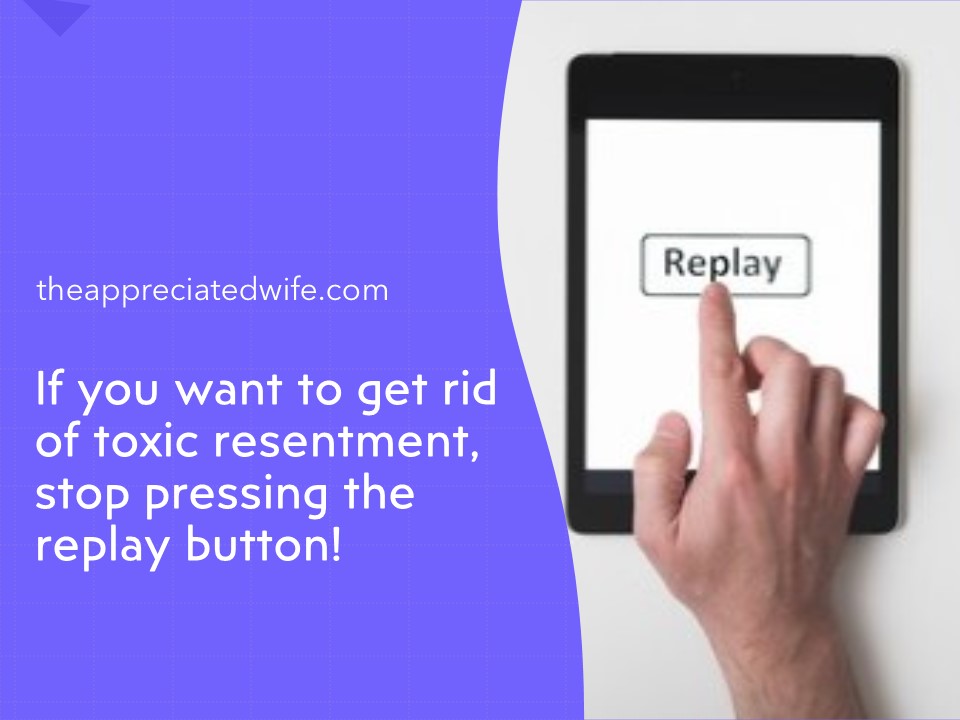
How can you get rid of this super destructive attitude of resentment? Here are some insights. Stop hitting the replay button on past hurts!  Choose this day to be thankful for what you do have.  Make a choice to have compassion on your offender, realizing that you’re not perfect either!  If the resentment stems from current behavior, then seek godly counsel on establishing boundaries in that relationship.  Finally, ask God to redeem your painful experience in some kind of way.  He loves to do that!  Romans 8:28 promises us that “in all things God works for the good of those who love Him who have been called according to His purpose.”

Relaunch your marriage!

Some of you have had a rough couple of months or couple of years in your marriage.  You may have a mountain-size load of resentment toward your husband.  Perhaps your husband also holds a gigantic amount of resentment toward you.  If this is you….if you find yourself in the pit of despair regarding your marriage, I want to encourage you to blow up that marriage.  Yep.  You heard me right.  Blow up your marriage in order to start fresh and build a better one, with the same husband!

Sometimes, we just need to start over when something in our lives has gone terribly wrong.  However, our first impulse is to throw out the whole thing; to discard the thing that has brought heartache and disappointment.  But that doesn’t give God any room to work, and that attitude basically lets both your husband and you off the hook in terms of making any changes in how you do relationships.   If you toss out your existing marriage, you’ll just bring the same dysfunctional patterns into your next relationship.

So, how about completely resetting your marriage?  Listen to what God says in Isaiah 43:18-19 “Forget the former things; do not dwell on the past.  See, I am doing a new thing!  Now it springs up; do you not perceive it?  I am making a way in the wilderness and streams in the wasteland”.  What if you were to apply those words to your marriage?  The devil wants to keep you focused on past hurts.  That way you will be forever stuck.  Don’t fall for his evil plot against you!  Starting today, stop dwelling on the past, sit down with your husband and ask him if he would be willing to start afresh, with BOTH of you putting actual daily effort into blessing the other, serving the other, speaking the other’s love language, and showing care for the other.  This attitude shift can accomplish absolutely amazing things!

Letting go is a must in marriage

I wonder how many marriages have been destroyed because one or both spouses refused to let go of an old offense, disappointment or sin of their mate?  It’s likely that the vast majority of divorces resulted from toxic resentment, stemming from the inability to let go of old offenses!

I know it’s so tempting to dwell on your husband’s failures or past sins against you, but if you allow yourself to do that, your heart will become consumed with resentment.  And I think we all know that resentment usually becomes poisonous to both you and the relationship.  Hebrews 12:15 puts it this way “Watch out that no poisonous root of bitterness grows up to trouble you, corrupting many”.

Also, when you keep bringing up that old sin, betrayal, disappointment or offense to your husband, you will slowly crush his spirit, and he will likely pull away from any further close connection with you.  That’s not exactly helpful to you, him or the relationship!

Now if your husband is CURRENTLY engaged in a betrayal or pattern of sin against you, you should seek wise counsel as you will likely need to confront the issue and establish firm boundaries.

However, if your husband is no longer engaged in a pattern of sin or betrayal, and if he shows some signs of repentance, you MUST choose to forgive him and leave the past in the past.  It is not helpful to keep wanting to talk to him about it.  It’s not helpful for you to keep bringing it up and throwing it in his face when you are disappointed or annoyed with him.  Let it go. 

Forgive as God forgave you.  Does God keep on bringing up your past sin and throwing it in your face?  No, he doesn’t.  Does God keep discussing your past failures with you, going over all the details of your past sin?  No, he doesn’t. He chooses to forgive completely.  Let us do likewise.

** or view this topic as a 3 minute VIDEO BELOW

Forgiveness and boundaries

For anyone who has read the Bible’s New Testament, it’s hard to escape God’s frequent instruction for us to forgive others who have wounded or offended us in some way. A prime example is Ephesians 4:32, “Be kind and compassionate to one another, forgiving each other, just as in Christ God forgave you.” Yet, many women struggle with what forgiveness actually looks like if the person who hurt you continues to pose emotional, mental, or physical danger.


Please allow me to share what I’ve learned after spending time studying the Bible and also helping numerous women grapple with forgiveness. Here’s the big takeaway. You can and must forgive the other person in terms of letting justice rest in God’s hands and choosing to avoid the temptation to hope (or make) them suffer for what they did. However, forgiveness does not necessarily mean you need to be in a close relationship with that person or leave your heart wide open for further damage.


God gives a really pivotal instruction in Proverbs 4:23 where He says, “Above all else, guard your heart for it is the wellspring of life”. That’s where boundaries come in. If the person who deeply hurt you is still posing a significant danger to your emotional, mental or physical health, it’s appropriate to guard yourself by establishing a boundary in the relationship. This might mean a season of separation from that other person. This might mean keeping yourself distant until you see signs that this person may no longer be a danger to you, or that you have undergone sufficient healing from the Lord so that you are now strong enough to be around this other person.


Yes, we must forgive, but we must also be wise in terms of guarding ourselves from further harm.

** or view this topic as a 2 minute VIDEO BELOW

Do you hit the replay button?

Do you keep replaying your husband’s past mistakes over and over again in your mind?  Do you find yourself dwelling on how he’s disappointed you in the past?  Let it go!  Thoughts like that become toxic…to you and your marriage.  Hebrews 12:15 makes this point:  “See to it that no bitter root grows up among you to cause trouble and defile many.”  If you keep rehearsing your husband’s past failures, you will end up growing more and more resentful of your husband.  The resulting bitterness acts like poison to your own heart.  You become a dried up, miserable woman. 

Even more damage is caused when you verbalize those past mistakes to your husband.  Yet many wives do that.  They repeatedly bring up their man’s past mistakes and almost wield them as a weapon against their husband.  His heart gets sliced and diced in the process.  His heart becomes poisoned against his wife as well.

It’s time to decide to release your husband from his past failures. The Bible is pretty clear about your need to release bitterness and resentment. Ephesians 4:31 says “Get rid of all bitterness, rage and anger…”  Sochoose to exercise the same grace God has given you!!  News flash:  You’re not perfect either.  By the way, releasing your man from his past mistakes doesn’t mean you should ignore current sin.  If he is currently sinning against you, determine to respectfully confront him and work through the problem, perhaps with the help of a counselor or pastor.

A simple challenge for wives

When’s the last time you said it?  You probably think I’m asking about the last time you told your husband “I love you”, but that’s not where I’m leading.  My question is this:  When is the last time you admitted to your husband that you were wrong?  We like to pretend as if we’re never “wrong”, but that’s not only prideful, it’s not true!

Think about it.  Have you been disrespectful toward your husband by rolling your eyes or by using cutting sarcasm?  Have you given him the look that basically says “you’re a jerk” or “you disgust me”?  Have you been stressed or frustrated about something unrelated to him and lashed out at your husband because he happened to be present?  (I’ve done that more than a few times! Ugh.)

If you want to be even more beautiful to your husband, be humble and admit when you are out of line or just plain wrong.  You might believe that confessing your wrongs will put you in a weak position in your marriage, but the opposite is true.  Proverbs 28:13 says “Whoever conceals their sins does not prosper, but the one who confesses and renounces them finds mercy.”  Oh, and by the way, instead of simply saying “I’m sorry”, go a step further in humility by saying “I was wrong. Please forgive me.”